


What Are Regular Acoustic Panels
Acoustic panels are large, soft-furnished panels that can be strategically placed within rooms to improve sound quality by absorbing reflected sound or echoes. They can be made from a vast array of materials such as a combination of foam and fabric, PET Eco Felt, Wood Wool, or biophilic elements like cork or moss. The acoustic panels can be made into a range of shapes and sizes and customised to complement the design of your space. The main purpose of acoustic panels is to remove residual sound in any space. When installed correctly in a room, acoustic panels can absorb or diffuse sound from the first point of reflection. The effectiveness of good quality acoustic panels means that you can use far less so that you’re not at risk of over-cluttering areas and spaces.
Advantages of Regular Acoustic Panels
Better speech intelligibility
If you are designing an area where conversation will be had, acoustics are a crucial component to your space. Whether it’s a restaurant, an event space, or just a home where a family will be living and conversing, the design of a space where people will be talking to each other should take acoustics into consideration. The reason for this is that an untreated room can often make conversation and socializing difficult, as voices, music and other sounds will all be bouncing off hard surfaces, resulting in thousands of sound reverberations at any point in time. Acoustic panels will absorb sound rather than reflecting it back into the room, which makes it easier for people to have conversation, hear music, and enjoy a relaxing atmosphere.
Reduced noise pollution
Noise pollution is excessive and unwanted sound that can have negative effects on health and well-being. Exposure to excessive noise can lead to stress, sleep disturbance, hearing impairment, and other health problems. It can also reduce cognitive performance, productivity, and communication. So, installing items that can reduce noise pollution is a great way to make your space more productive, relaxing, and even healthy, depending on its use. Regardless of the environment, acoustic paneling will significantly reduce noises and echoes, making your space free of noise pollution and improving the health of those who spend time there.
Enhanced productivity
The use of acoustic panels in workspaces and offices is seen to have improved the productivity levels of the employees. Bad office acoustics can irritate employees and make it difficult for them to concentrate and stay focused.
Improved aesthetics
If you opt for design-forward decorative acoustic panels that match the theme of your space, they can improve the aesthetics as much as the acoustics. While painted walls may seem good enough, adding natural elements like wood to the walls of your space can truly give any room a more sophisticated, elevated look. Panels like these are also great for hiding unsightly characteristics on your wall or ceiling, like chipped paint, hairline cracks, and other imperfections.



Why Choose Us
Our factory
Our factory located in Shandong Province, conquer more than 10,000 m2. We have about 20 advanced equipment and 60 experienced workers.
Best worthy product
At the same time following strict quality control procedures adopt good row materials ensure we can provide clients best worthy product.
Product application
Wooden slat acoustic panel as a new wall panel sort, become more and more hot sale on the indoor decoration wall panel material market. It’s easy to install not hard to transport. It based on the noise absorb function also famous of good look and nice price.
Our service
Of course we offer any customized service. Expect those we can promise you that you may always find cheaper and cheaper product, we are the best worthy one. If you are looking for a reliable supplier and nice price with good quality product to help you win more profit. We won’t let you down. So just move on, sample is free.
Types of Regular Acoustic Panels
Acoustic panels come in various types, including fiberglass, foam, wooden, and ceiling tiles. Fiberglass panels are lightweight, durable, and highly effective at absorbing sound, while foam panels are a popular choice for low-budget projects where acoustics are more important than aesthetics. Wooden acoustic panels are often used for decorative purposes, and ceiling tiles are often a popular choice for commercial buildings.
Fiberglass acoustic panels
If you are just starting your search for acoustic panels, there is a high probability you will come across fiberglass as a popular material, as it is known for being lightweight, easy to install, and very sound absorptive. Besides, it is one of the oldest materials used to make acoustic panels, so it’s considered a reliable, economic choice. Fiberglass panels are not directly installed but wrapped in a covering. The ideal type of covering for you greatly depends on the application. For example, if you are concerned with the aesthetics of the space, fabric covering is the ideal choice. Fabric coverings come in all types of designs, so you can easily match them with the theme of your space. The material of the acoustic panels affects their sound-absorbing tendency. Fiberglass absorbs more sound waves than most other materials used to make acoustic panels. So, it’s a great choice where acoustics and budget are top priorities.
Foam acoustic panels
You must have seen those diy sound booths in home studios made with a soft material all over the walls and ceilings. That material is typically foam (often in a convoluted or fluted pattern) and it is one of the most commonly used materials in acoustic panels. If you are a beginner and don’t know much about acoustic panels, deciding on the panels' material becomes difficult. However, opting for foam panels is usually a safe bet, especially if you’re working on a budget and don’t want to have to wrap your panels, as you would with fiberglass acoustic panels. The best part about foam panels is that they are very affordable. So, if you can’t afford to invest too much money in acoustic panels, foam panels can serve their purpose well. As for the aesthetics, they might not be the most attractive thing to install in their room, but you can rely on them to reduce extra noise. Also, cleaning them is not easy. Dust gets easily trapped in the pores of the foam and doesn’t come out easily with a vacuum. The relatively delicate nature of the foam can also result in the panels becoming easily damaged if you try to clean them, so make sure you install them in environments where there won’t be much dust, or the dust won’t be very visible (like a dimly-lit home studio).
Wood slat wall panels
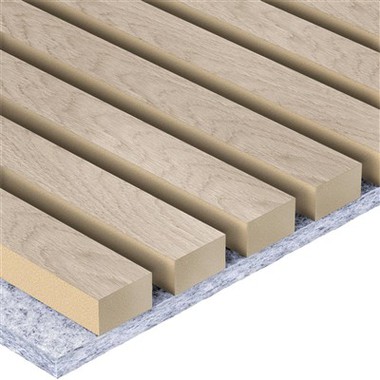
If you actively work towards achieving sustainability and you want your acoustic panels to actually look nice in your space, wood slat acoustic panels might be your best option. These acoustic panels are made from a combination of an acoustical felt backing, mdf, and real wood veneers. Their fluted wood panel design adds to their acoustic performance, as sound waves are caught between the slats and in the felt backing, reducing echo by up to 85%. Another great thing about this panel design is its ease of installation. While most wooden acoustic panels must be installed by professionals using a complex array of tools and measurements, these wood slat acoustic panels are almost as simple as foam panels when it comes to installation. Simply use black screws or nails to screw through the black acoustical felt backing and attach them to your wall or ceiling.
Acoustic panels serve a very simple purpose. They introduce porous materials and density to the space. When sound waves impact hard surfaces, they reflect back into the room. The flatter those surfaces the more direct the reflections. Direct reflections can lead to audio issues in rooms, like echo and reverberation.
Echo
You’re no doubt familiar with the sound of an echo. We play with it as kids and notice it occasionally in the real world. It may be more pronounced in large spaces like gyms and mountain valleys, but echo occurs in smaller spaces too. Even if the echo isn’t as noticeable as it is in larger spaces, it can still cause problems with speech intelligibility. The reflected sound waves compete with our speech and that makes it harder to hear. As a result, we speak loudly to be heard. This only makes communication more difficult. So if there’s nothing to soak up those waves, they can build up and cause problems.
Reverberation
When reflected sound waves build up in the room, it creates what is known as reverberation, or reverb. Since those sound waves are reflected back into the room and don’t disappear, the result is additive. Those waves mix in the room and become louder together. This increases the overall ambient volume in the room and can become unpleasant if not taken care of. The way to combat echo and reverb is to introduce dense, porous materials to absorb excess waves. The most popular way to do this is with sound panels. This is because they absorb vibrational energy better than most materials on the market, and they look great doing it.

Applications of Regular Acoustic Panels
Home offices
Working from home has become the norm for many of us, but that doesn’t mean our homes are particularly well-equipped to serve as offices.Installing a soundproof wall of acoustic slatted panels can help to minimise distractions and create an atmosphere which is more conducive to long-term concentration.
Studios
Anyone who’s ever had to record sound for a project knows the value of professional-grade soundproofing.Tinny echoes will absolutely ruin any attempts to get a clean, rounded, robust recording – be it for content creation, audiobook narration, or music production. To create a budget-friendly studio space with solid, trustworthy acoustics, try acoustic wall panels.
Office buildings
Similarly, employers welcoming their employees back to office work will have noticed that “back to normal” is not a phrase that can readily be applied. Instead, employees returning to the office are finding that the old-school way of doing office work no longer suits them. More and more employers and office architects are understanding the necessary role of mental health and acoustics for productivity in the design of their buildings. Strategically placed acoustic wall panels can not only make office spaces quieter and more productive, but also homelier and more welcoming at the same time.
Bedrooms
Some of us are heavy sleepers; most of us are not. Excessive noise from outside or other rooms in the house can throw a spanner in the works of our attempts to get a good night’s sleep. Thankfully, by installing acoustic slat wall panelling in your bedroom, you not only get a gorgeous revamp of your interior design, but you also minimise the chances of being disturbed by someone else’s music, cars, or conversation.
Living rooms
I don’t know about you, but when i’m cooried up on the sofa for a sunday movie sesh, or sitting in my armchair listening to my records, I want to get the best sound quality from my entertainment as possible. Installing a feature wall of soundproof boards behind your tv and speakers is a one-way ticket to an enhanced audio experience worth shouting about!
Kitchens
Finally, it’s worth noting that just because acoustic wall panels have phenomenal acoustic properties, that doesn’t mean they can’t be installed for the pure aesthetics. For example, a run of acoustic slat wall panelling could really elevate your kitchen’s worktop spaces with a chic, modern scandi infusion.

The number of acoustic panels you would need would depend on the size of the room, the amount of noise coming from outside, and how much echo you want to reduce. In general, more acoustic panels will result in a deader space.
As a general rule of thumb, covering 30-40% of the wall surface area with is a good starting point to hear a difference. However, factors such as wall/ceiling surfaces and windows may require a unique approach. Ceiling panels are often the most effective sound absorbers and we recommend these for almost all projects, although not always practical.
If you are trying to completely block out outside noise, you will need more than acoustic panels than if you are merely trying to reduce echo in a room. The size of the room will also affect how many acoustic panels you need. A smaller room will require fewer panels than a larger room. For open plan offices, there is a specified British standard which sets out guidelines for acoustic treatment in commercial building.
In general, it is best to consult with a professional to determine how many acoustic panels you need for your specific situation. They can take into account all of the factors mentioned above and help you choose the right number of panels for your needs.
Health and safety of the acoustical panel
An acoustic panel should add to the space's safety, particularly regarding fire and air quality: Class a fire-rated panels will contribute to the room's safety and building code requirements. Avoid panels with formaldehyde. Many manufacturers use a formaldehyde binder during production for its low cost and availability. Formaldehyde can irritate the nose, eyes, and throat at low levels. High levels can cause coughing, choking, throat swelling, or even chemical burns to the lungs.
Durability and lifespan
The acoustic panel should maintain its integrity for its desired lifespan.
Acoustical performance of the acoustic panel
You can compare the acoustic performance of the acoustic panel by looking at its noise reduction coefficient (nrc) and density. The noise reduction coefficient (nrc) indicates how much sound an acoustic panel absorbs within a room. For example, an acoustic panel with an nrc of 0.80 will absorb 80 percent of sound reaching it. The astm c423, standard test method for sound absorption and sound absorption coefficients by the reverberation room method, measures the nrc. The greater the nrc, the better the panel absorbs sound. Manufacturers produce acoustic slabs at a higher density than other forms of insulation, like low-density thermal insulation. Sound insulation slabs start at a minimum density of 2.8 lb/ft3 (45 kg/m³). The density of the panel determines its ability to absorb the frequency. The higher the density, the more efficiently the panel will absorb low frequencies (150hz+). However, if the panel is too dense, the high frequencies will reflect back into the room. The best acoustic panel will provide balance absorption, i.E., about 6 lb/ft3 (96 kg/m³).
Ease of handling the acoustic panel
Consider the ease of handling the panel: Does it require protective equipment to handle, like masks and gloves?
Sustainability
Consider the impact of the product on the environment: Does the manufacturer use recycled products? Can you recycle the panel?
Fabric cover of acoustic panel
The fabric covering of the acoustic panel provides aesthetics; however, the right fabric can also help ensure the success of the acoustic filling at controlling sound. Fabrics should provide durability for the lifespan of the panel and acoustic permeability to ensure the sound makes its way through the fabric.
Certificate


Our factory
Our factory has been served over hundreds clients. We have about 20 advanced equipment and 60 experienced workers. At the same time following strict quality control procedures adopt good row materials ensure we can provide clients best worthy product. We have professional packing machine can do particular B2B or B2C package,whether the outer or the inner package. Our R&D department also can help you do your own package design to make your own brand. Indoor decoration of wall and can absorb noise echo etc. Wooden slat acoustic panel as a new wall panel sort, become more and more hot sale on the indoor decoration wall panel material market. It's easy to install not hard to transport. It based on the noise absorb function also famous of good look and nice price. High quality products give customers a greater advantage in market competition, we never engage in price competition because low-priced products are always of low quality, which goes against our company's positioning.


FAQ
As one of the leading regular acoustic panels manufacturers and suppliers in China, we warmly welcome you to wholesale high quality regular acoustic panels in stock here from our factory. Contact us for more details.
Technical Grey Oak Veneer Acoustic Panels, Fireproof Marbling Veneer Acoustic Panels, natral wood veneer surface acoustic panels